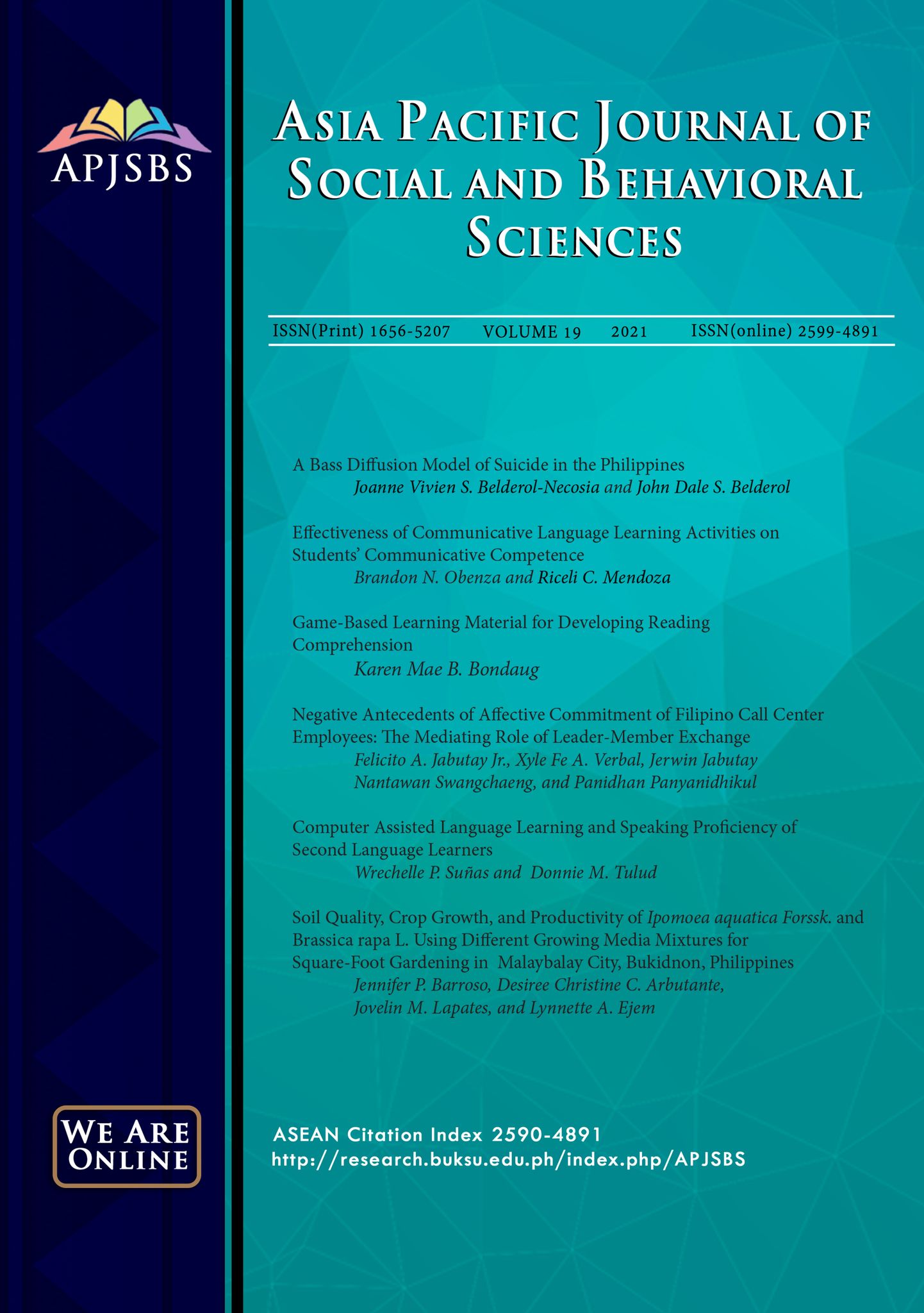
Soil Quality, Crop Growth, and Productivity of Ipomoea aquatica Forssk. and Brassica rapa L. Using Different Growing Media Mixtures for Square-Foot Gardening in Malaybalay City, Bukidnon, Philippines
DOI:
https://doi.org/10.57200/apjsbs.v19i0.277Keywords:
Soil quality, plant growth, crop productivity, organic urban gardening, squarefoot gardeningAbstract
Organic manures have long been used by farmers for the availability of nutrients for plant growth, and to improve soil quality. But the kind and amount of organic media most beneficial to the growth of kangkong (Ipomoea aquatica Forssk.) and pechay (Brassica rapa L.) are uncertain. This study investigated the effects of growing media mixtures (GMM) with different amounts of chicken manure and vermicast on the growth and productivity of the selected vegetables. The study aimed to assess the quality of the GMM with differentamounts of chicken manure and vermicast in terms of pH, organic matter, total nitrogen, extractable phosphorus, and exchangeable potassium, determine the effect of different GMM on the growth and productivity of I. aquatica and B. rapa in terms of average plant height, leaf width, the number of leaves, and fresh weight of plants, and determine the best-growing media mixtures for the growth and productivity of the experimental plants. Results show that the growing media mixture with optimum pH range, high OM, N, P,and K contents have biological and nutrient essential for plant growth and productivity. T10 yielded kangkong with the broadest leaf width, the greatest number of leaves, and heaviest fresh weight, while T9 produced the tallest, broadest leaf, greatest number of leaves, and heaviest pechay. Overall, T10 is the best growing media for kangkong. Whereas T9 is optimum for cultivating pechay. Results indicated that chicken manure and vermicast enriched growing media mixture build healthy soil for improved growth and productivity of kangkong and pechay.
Downloads
Published
Issue
Section
License
Copyright (c) 2021 Asia Pacific Journal of Social and Behavioral Sciences

This work is licensed under a Creative Commons Attribution-NonCommercial-ShareAlike 4.0 International License.