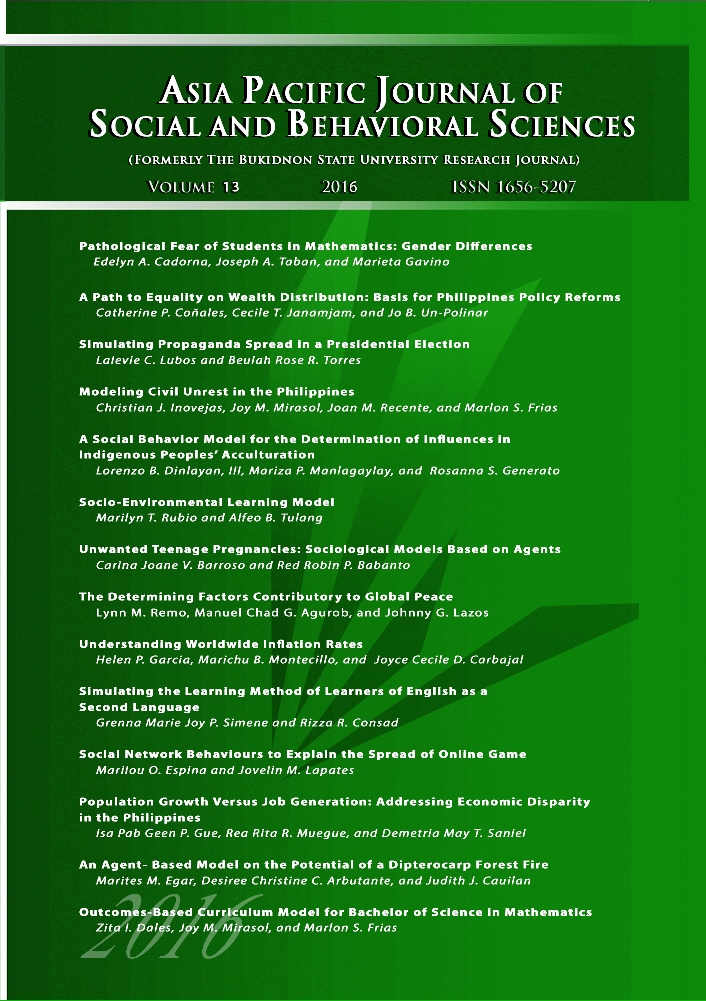
A Path to Equality on Wealth Distribution: Basis for Philippines Policy Reforms
DOI:
https://doi.org/10.57200/apjsbs.v13i0.116Keywords:
Wealth, distribution of wealth, inequality, population, policyAbstract
This study examined the wealth distribution parameters towards equality. The NetLogo Wealth Distribution Model was used to determine the Gini Coefficient based on the interactions of the parameters such as population, perception in life, lifestyle, minimum life expectancy, maximum life expectancy, income opportunities, skills, and labor market. Various simulations were conducted to identify the numerical values of the parameters leading to the desired state of wealth distribution. The result showed that among the parameters used, population has the highest impact in achieving an ideal state of equality. The increase in population will affect the result of the Gini coefficient, which tends to deviate from the perfect equality curve. Based on the Gini index of the Philippines, it revealed that wealth distribution in the country is significantly unequal, influenced by growing population and poor policy implementation. This research could serve as a basis for policy reforms which would lead to the country's economic growth and stability.
Downloads
Published
Issue
Section
License
Copyright (c) 2016 Asia Pacific Journal of Social and Behavioral Sciences

This work is licensed under a Creative Commons Attribution-NonCommercial-ShareAlike 4.0 International License.