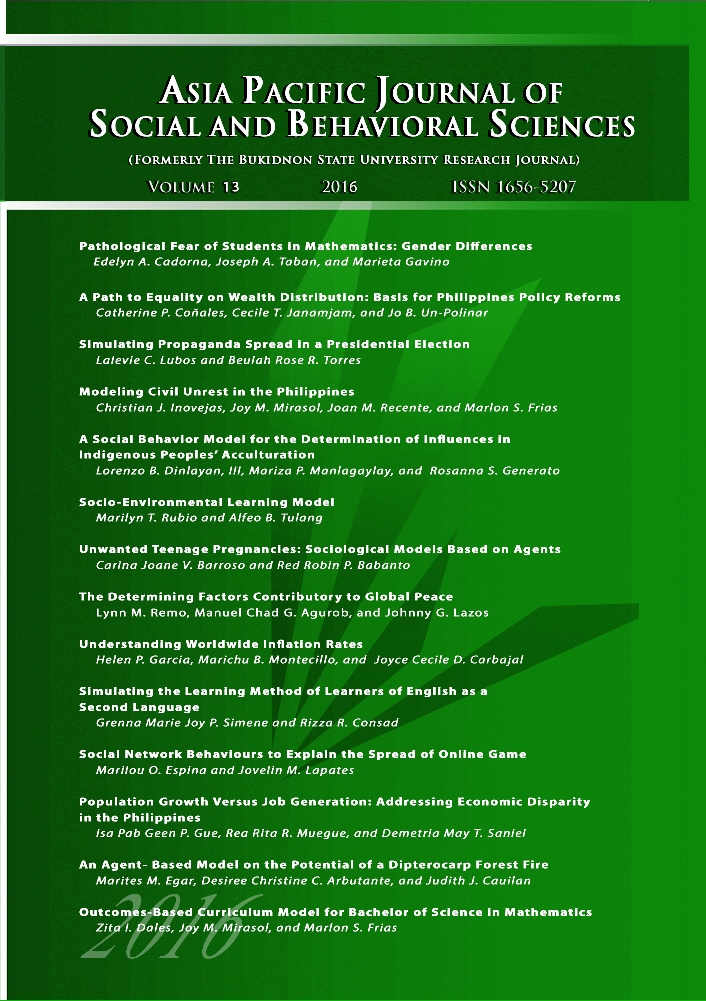
Simulating Propaganda Spread in a Presidential Election
DOI:
https://doi.org/10.57200/apjsbs.v13i0.117Keywords:
Rumor Mill Model, political propaganda, presidential election, tagline, Net-logo, ModelAbstract
The presidential election process in a democratic country entails a political campaign that includes the spread of propaganda which refers to any information that aims to persuade voters to elect a candidate. This information may be in a form of a tagline or slogan that briefly explains why a candidate is running for office. Within the context of the 2016 Presidential Election in the Philippines, the purpose of this paper was to simulate through the Rumor Mill Model the spread of a presidential candidate's tagline as propaganda; and to determine whether the speed and extent of propaganda reach was translated into votes. To accomplish this, a one-on-one correspondence of each presidential aspirant's tagline, with the parameters of the model was created. A specific assumption for each parameter was formulated. Then based on the computer instructions of the model, the spread of propaganda was simulated. The result did not match with the official results of the 2016 Philippine presidential race. Hence, the Rumor Mill Model failed to predict who won in the election. It is therefore necessary to design additions and extensions to improve this model as an agent-based simulation model.
Downloads
Published
Issue
Section
License
Copyright (c) 2016 Asia Pacific Journal of Social and Behavioral Sciences

This work is licensed under a Creative Commons Attribution-NonCommercial-ShareAlike 4.0 International License.