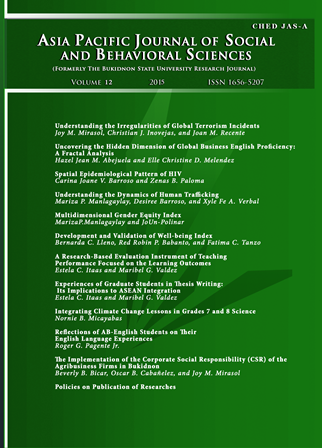
Uncovering the Hidden Dimension of Global Business English Proficiency: A Fractal Analysis
DOI:
https://doi.org/10.57200/apjsbs.v12i0.50Keywords:
Business English Index, Business English proficiency, fractal dimension, language proficiencyAbstract
This study used the fractal statistical analysis to explain the Business English proficiency of 137,000 employees in multinational companies across 77 countries. Using the Global Business English Index (BEI) in 2013, this study compared and contrasted the natural and the normal states of English proiciency in three contexts of English use following the Kachruvian model: English as a Mother Tongue (EMT), English as a Second Language (ESL) and English as a Foreign Language (EFL); and subsequently, described the local characteristics of these countries to account for the fractal deviation. The results revealed that countries such as Bulgaria, Singapore, India, Sweden, Finland, and Belgium and the Philippines deviated from the natural state with BEIs of 6.076 to 6.575 (Basic Proficiency) and 7.95 (Intermediate Proficiency) respectively. The fractal variation could be attributed to two local characteristics of these countries: the sociolinguistic profile of the test takers and the provision of language training in multinational companies.
Downloads
Published
Issue
Section
License
Copyright (c) 2015 Asia Pacific Journal of Social and Behavioral Sciences

This work is licensed under a Creative Commons Attribution-NonCommercial-ShareAlike 4.0 International License.