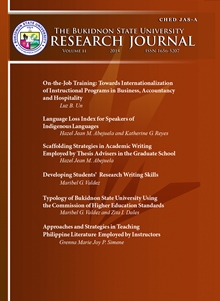
Language Loss Index for Speakers of Indigenous Languages
DOI:
https://doi.org/10.57200/apjsbs.v11i0.44Keywords:
Indigenous language, language loss, multidimensional index of indigenous language lossAbstract
Monitoring the status of indigenous language is an urgent call in recent years. This necessitates the development of mechanisms that would examine the state of endangered languages across ethnolinguistic groups. This study aimed at (1) developing a multidimensional index of indigenous language loss in five domains: home, social interaction, workplace, academe, cultural and language loss; 2) determining the appropriate weight for each domain; and 3) validating the index through a pilot sample. Findings revealed that Binukid, the indigenous language of Malaybalay is partially lost, i.e., it is no longer used in two domains, in school, and social interaction. This decline is critically engendered by various factors such as speech community reduction, language competencies, the presence of other languages, frequency and motivation of Ll use. However, the indigenous language is supported and maintained in the home, cultural/religious and even in the workplace domains. Further, educational attainment, language used and age (especially among the school-going participants) are the variables that significantly correlate with language loss. With the development of the index, it is hoped that language planners and educators will be guided in assessing the state of heritage languages and subsequently in formulating sociolinguistic policies and programs.
Downloads
Published
Issue
Section
License
Copyright (c) 2014 Asia Pacific Journal of Social and Behavioral Sciences

This work is licensed under a Creative Commons Attribution-NonCommercial-ShareAlike 4.0 International License.