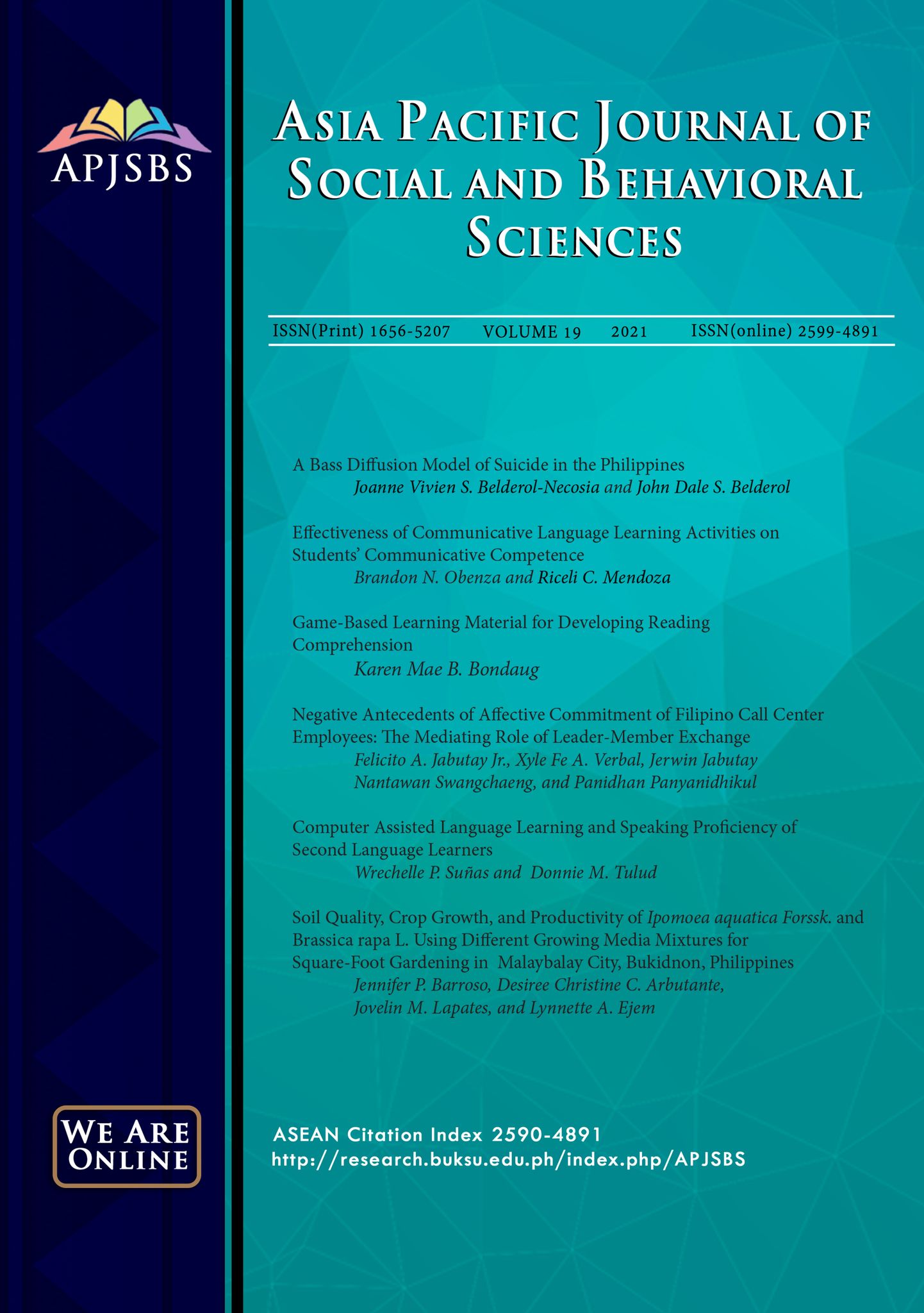
Negative Antecedents of Affective Commitment of Filipino Call Center Employees: The Mediating Role of Leader-Member Exchange
DOI:
https://doi.org/10.57200/apjsbs.v19i0.275Keywords:
Call center, affective commitment, perceived customer unfriendliness, emotional dissonance, perceived stressAbstract
The study aims to provide empirical evidence on the effects of perceived customer unfriendliness, emotional dissonance, and perceived stress on Filipino call center employees’ affective commitment. Also, the study intends to show how leader-member exchange (LMX) mediates the relationships between the three posited antecedents and affective commitment. The study further proposes a hypothesized model based on insights from the literature. Structural equation modeling (SEM) was used in testing the hypotheses using a dataset from a sample of 689 Filipino call center employees. The results revealed that emotional dissonance and perceived stress are consequences of perceived customer unfriendliness. They, in turn, posited adverse effects on affective commitment. The results also indicated that LMX exercised a fully mediating role on perceived customer unfriendliness and affective commitment while partially mediating the stress-commitment relationship. The findings highlight the importance of stakeholders’ intervention programs in decreasing employees’ emotional dissonance and perceived stress. It further implies that quality LMX initiated by leaders may also facilitate in reducing the adverse effects of customer-related stressors and psychological strains on the affective commitment of Filipino call center employees.
Downloads
Published
Issue
Section
License
Copyright (c) 2021 Asia Pacific Journal of Social and Behavioral Sciences

This work is licensed under a Creative Commons Attribution-NonCommercial-ShareAlike 4.0 International License.