
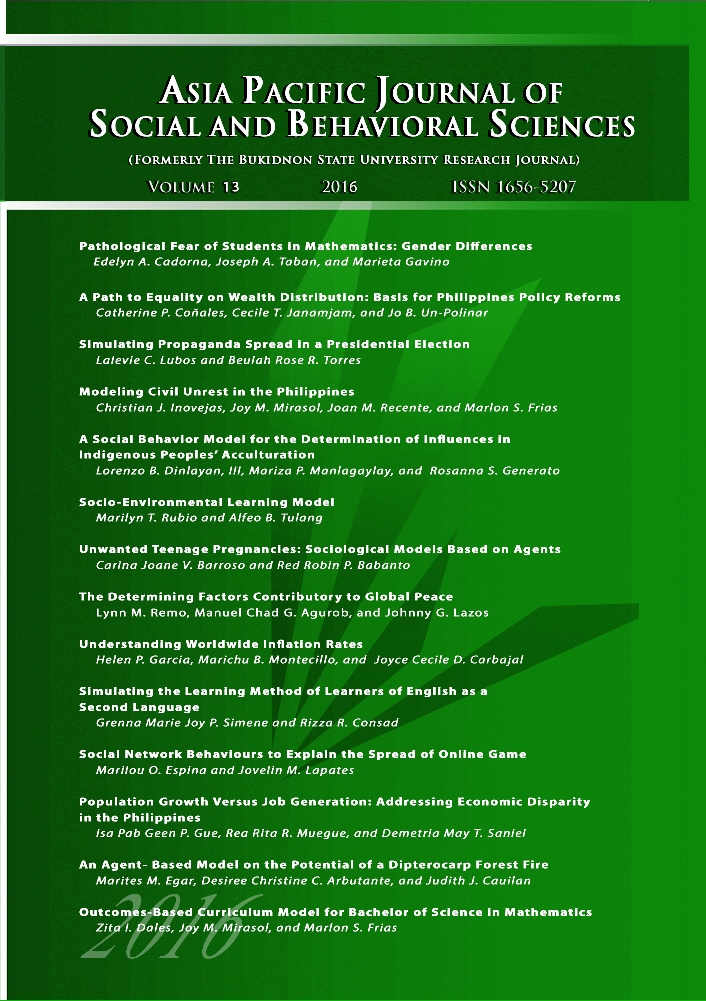
Understanding Worldwide Inflation Rates
DOI:
https://doi.org/10.57200/apjsbs.v13i0.123Keywords:
Inflation, politics, fiscal policy, monetary policy, World BankAbstract
This study examines the inflation rates of 215 countries in 2013. Researchers took the data from World Bank database, and fractal analysis was used to determine the hidden dimensions why countries have diverse inflation rates beyond the four identified factors. These factors are money supply, commodity prices, employment rate, and production capacity. The characteristic of inflation is the rate at which the general level of prices of goods and services increase. The result showed that there were countries that had extremely high or low inflation rates. Most of these countries that suffered extremely low inflation are in Africa, one in Europe and one in South America. World Bank established an ideal inflation rate of 2%. The majority of the countries in Europe, America and Asia, had stable inflation figures. Fractal analysis showed politics as the hidden dimension of the changes in inflation rates.
Downloads
Published
Issue
Section
License
Copyright (c) 2016 Asia Pacific Journal of Social and Behavioral Sciences

This work is licensed under a Creative Commons Attribution-NonCommercial-ShareAlike 4.0 International License.