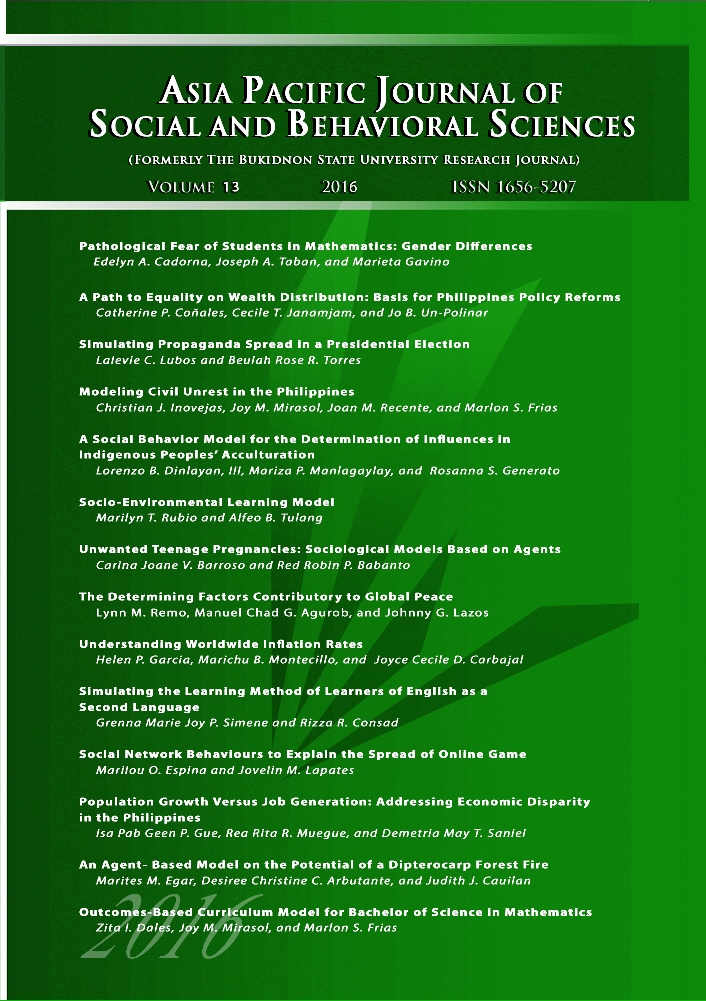
Modeling Civil Unrest in the Philippines
DOI:
https://doi.org/10.57200/apjsbs.v13i0.118Keywords:
Agent-based Modeling, civil unrest, rebellion model, perceived governance, civil unrestAbstract
This study compares Civil Unrest Model (modified from Netlogo's Rebellion Model) simulation with the actual historical data on civil unrest in the Philippines from 1998-2015. This is intended to determine the viability of using this model in determining maximal values to forecast possible incidents of civil unrests in the Philippines. Using the Civil Unrest Model and the actual historical data, findings showed that incidents of civil unrest vary across three administrations depending on the perception of governance manifested through the approval and trust ratings of the central authority. However, when historical data on the terrorist incidents were compared, the presidency of Estrada and Arroyo showed that perceived governance inversely relates to the percentage of active agents. The simulated results for the two administrations coincide with the historical Uppsala Conflict Data Program. The presidency of B. Aquino's perceived governance (high) diverged from the two previous presidencies as conflict incidents during his term are significantly higher.
Downloads
Published
Issue
Section
License
Copyright (c) 2016 Asia Pacific Journal of Social and Behavioral Sciences

This work is licensed under a Creative Commons Attribution-NonCommercial-ShareAlike 4.0 International License.