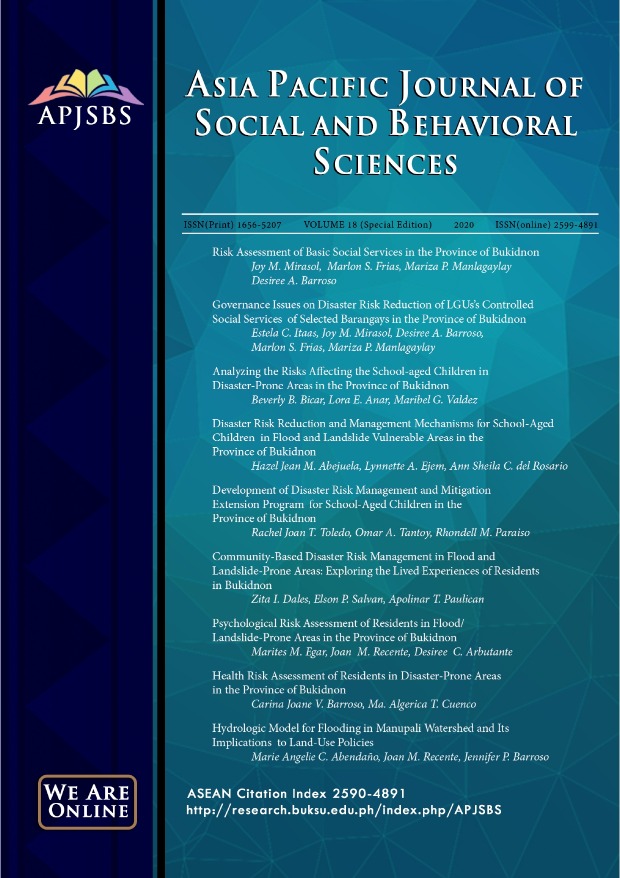
Risk Assessment of Basic Social Services in the Province of Bukidnon
DOI:
https://doi.org/10.57200/apjsbs.v18i0.228Keywords:
Disaster risk assessment, adaptive capacity, hazard, social services, reductionAbstract
This study conducted a risk assessment and formulated a model to measure the disaster risk reduction of selected flood-prone and landslide-prone barangays in the Province of Bukidnon. It specifically focused on the basic social services on food, water, electricity, and health. Primary and secondary data were used to establish hazard and population density maps to determine the exposure of communities during disasters. Further, the adaptive capacity (CA) of a local government unit (LGU)to respond to disasters was computed. Key findings revealed that exposed communities could be classified into various levels of susceptibility. Using the model, results revealed that the reduction of risk depends on the adaptive capacities and risks of LGUs. Further, efficiency to address risk is a ratio between the adaptive capacity and risk. Thus, the higher the adaptive capacity of LGUs would mean better efficiency in disaster risk reduction.
Downloads
Published
Issue
Section
License
Copyright (c) 2020 Asia Pacific Journal of Social and Behavioral Sciences

This work is licensed under a Creative Commons Attribution-NonCommercial-ShareAlike 4.0 International License.