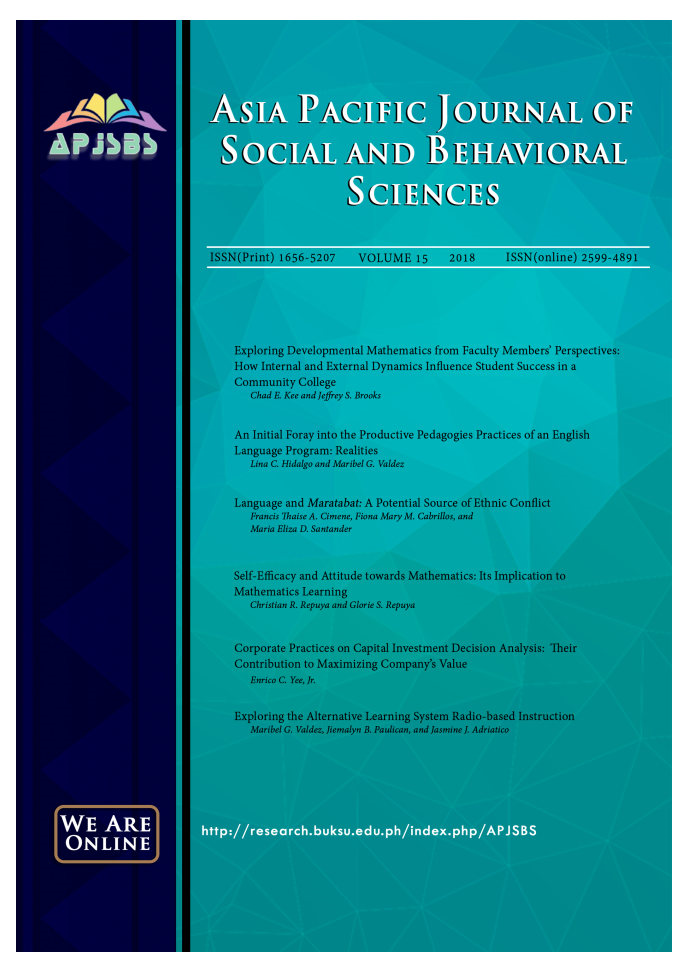
Exploring Developmental Mathematics from Faculty Members’ Perspectives: How Internal and External Dynamics Influence Student Success in a Community College
DOI:
https://doi.org/10.57200/apjsbs.v15i0.147Keywords:
Developmental mathematics, college readiness, community college structure, community college teaching, student learningAbstract
Recent studies have shown that successful completion of developmental mathematics can impact students' academic achievement and completion of their educational goals. However, few studies have examined the internal and external dynamics that can influence students' level of engagement in developmental mathematics. The following research question guided the study: what internal and external dynamics influence student success in developmental mathematics at a community college? Exploratory case study using qualitative methods of data collection was employed: interviews with developmental mathematics instructors at a community college located on the east coast of the United States, observations of developmental mathematics classes, and analysis of documents to understand the issue from multiple perspectives. The findings indicated that internal dynamics related to the need for changes in institutional policies and guidelines can influence success in mathematics. In addition, external dynamics such as secondary schooling practices and local business involvement in the curriculum can weaken or strengthen the mathematics pipeline and influence student engagement. Therefore, the importance for institutional leaders and partners to examine practices that may impede student academic achievement is discussed.
Downloads
Published
Issue
Section
License
Copyright (c) 2018 Asia Pacific Journal of Social and Behavioral Sciences

This work is licensed under a Creative Commons Attribution-NonCommercial-ShareAlike 4.0 International License.