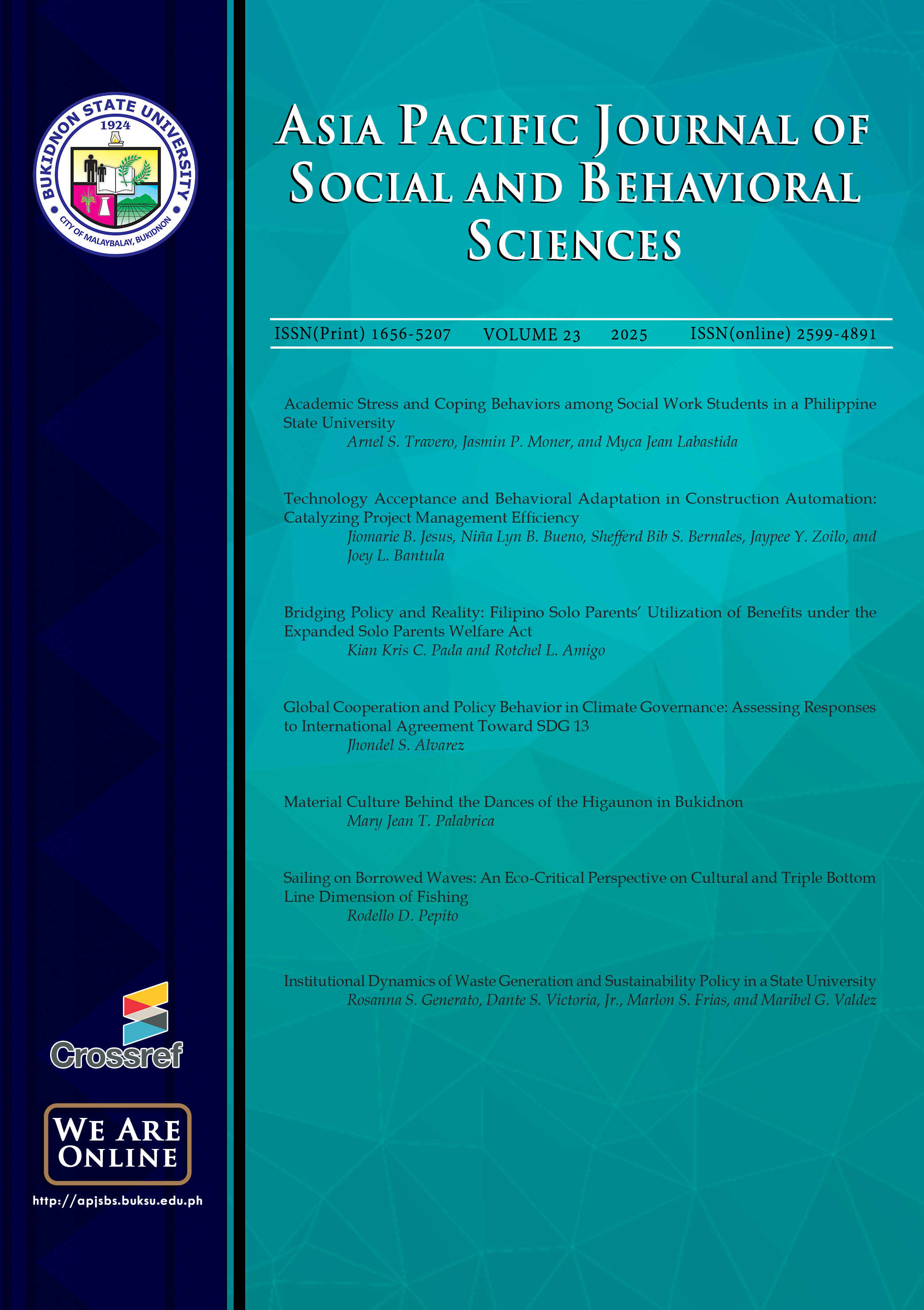
Sailing on Borrowed Waves: An Eco-Critical Perspective on Cultural and Triple Bottom Line Dimension of Fishing
DOI:
https://doi.org/10.57200/apjsbs.v23i0.460Keywords:
Bartering, bayanihan spirit, dimension of fishing, paluwagan, Triple Bottom LineAbstract
This study investigated the cultural, ecological, and economic dimensions of fishing practices in Barangay Santiago, Philippines, through an eco-critical lens and the Triple Bottom Line (TBL) framework. Focusing on boat-reliant fishermen who harvest from lakes, rivers, and seas, the research explored how ancestral beliefs, environmental awareness, and informal financial systems shape their livelihood. Using a combination of indigenous and descriptive research methods, data were collected through structured interviews with community members to examine their relationship with nature, traditional customs, and adaptive strategies. The eco-critical approach revealed that fishermen relied on natural signs such as moon phases, cloud formations, and seasonal shifts to guide their fishing decisions, reflecting a deep ecological consciousness. Economically, they navigated fluctuating market conditions through informal systems such as paluwagan, bartering, and high-interest lending rooted in trust and communal responsibility. Despite modernization, fishermen maintained traditional practices while adapting to new financial realities, demonstrating resilience and cultural integrity. Their enduring sense of bayanihan enabled them to respond to environmental disruptions and economic uncertainty. Overall, the study affirmed that fishing in Barangay Santiago is not merely a means of survival but a culturally embedded, ecologically attuned, and economically adaptive practice embodying the principles of sustainability central to the TBL framework.
Downloads
Published
Issue
Section
License
Copyright (c) 2025 Asia Pacific Journal of Social and Behavioral Sciences

This work is licensed under a Creative Commons Attribution-NonCommercial-ShareAlike 4.0 International License.