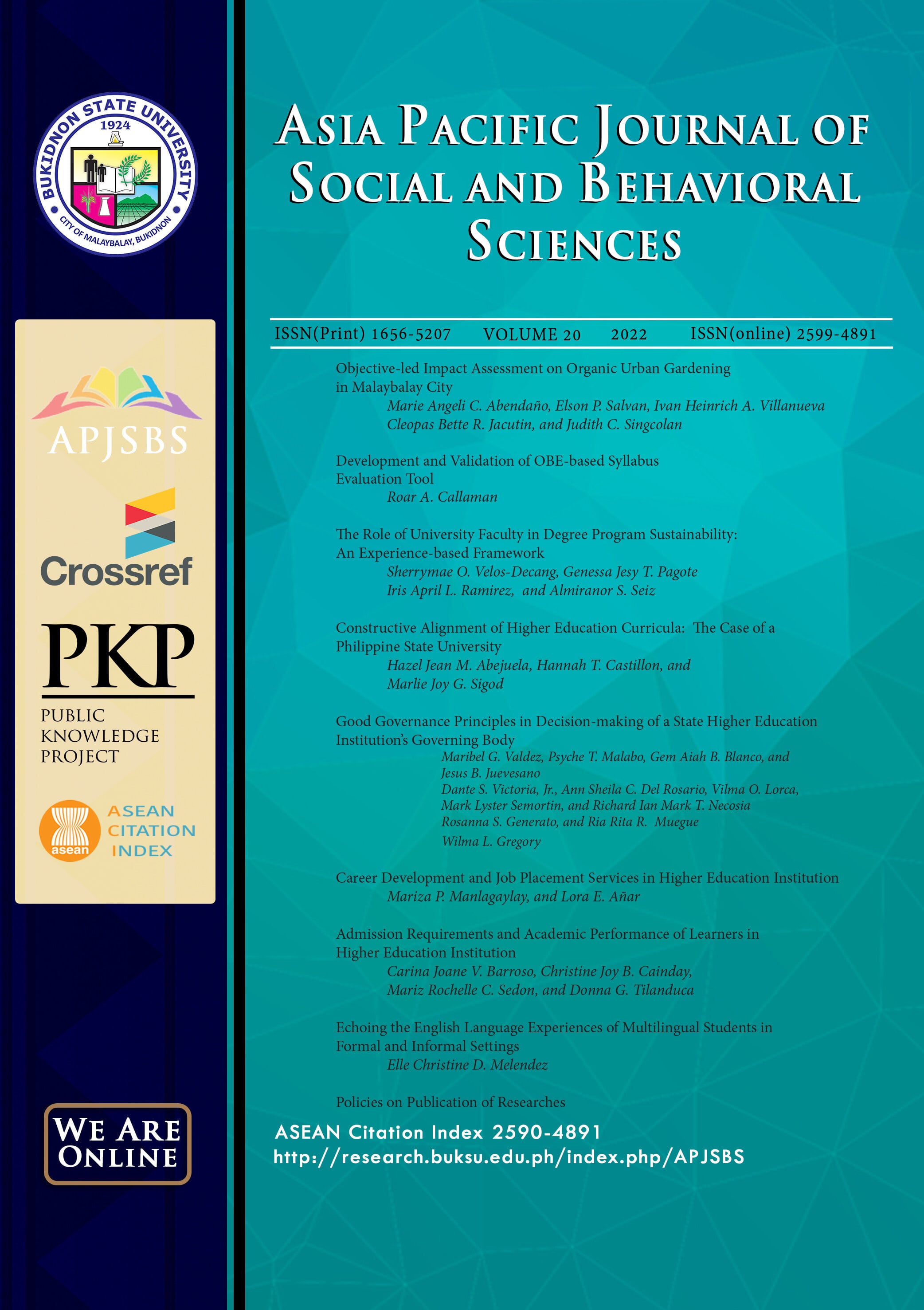
The Role of University Faculty in Degree Program Sustainability: An Experienced-Based Framework
DOI:
https://doi.org/10.57200/apjsbs.v20i0.286Keywords:
Experienced-based framework, faculty role, program sustainability, university faculty, success factorAbstract
Faculty members play a crucial role in defining “quality education.” Sustainability has received increasing attention in the management of education over the past years. This study focused on the specific role of faculty in the sustainability of degree programs in a State University or College (SUC) and developed an experience-based framework. Hermeneutic phenomenological research design was used in this study. Findings show that the SUC faculty do not have a single role, but instead fulfill many roles that ensure the success of their students. The implementation of flexible teaching within a class dictates an adjustment of the faculty’s role. Such adjustment requires them to possess knowledge not just as educators but as versatile persons. Good teaching implies the preparation of many activities and performance of tasks to ensure that all learners receive quality instruction. Furthermore, it was found that the faculty could be a resource provider, instructional and curriculum specialist, project coordinator, and many other roles. It is concluded that the contribution of the faculty is the most critical success factor in an academic program’s sustainability and development.
Downloads
Published
Issue
Section
License
Copyright (c) 2022 Asia Pacific Journal of Social and Behavioral Sciences

This work is licensed under a Creative Commons Attribution-NonCommercial-ShareAlike 4.0 International License.