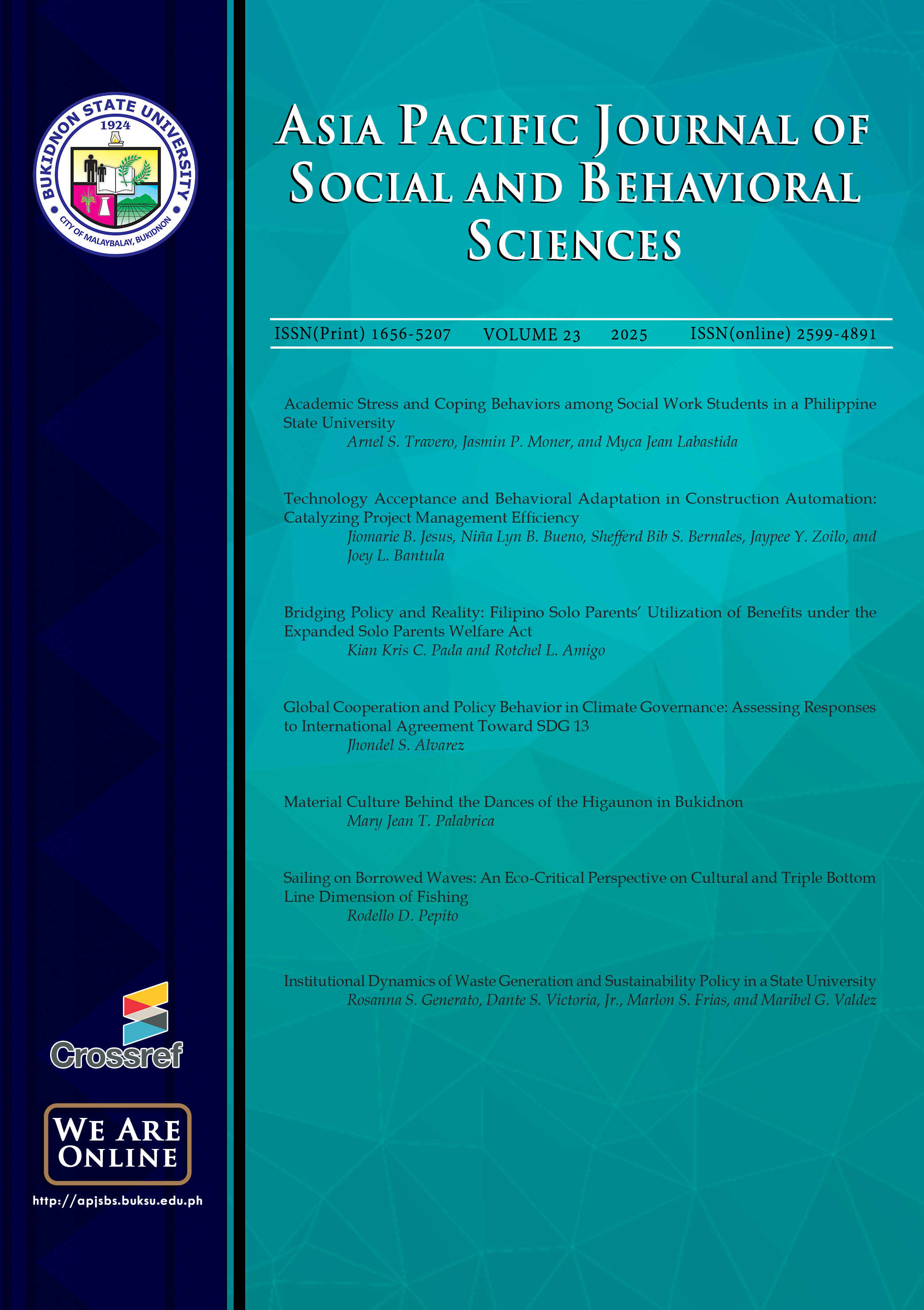
Global Cooperation and Policy Behavior in Climate Governance: Assessing Responses to International Agreement Toward SDG 13
DOI:
https://doi.org/10.57200/apjsbs.v23i0.458Keywords:
Carbon emissions, climate policy, SDG 13, global cooperation, Kyoto Protocol, Paris AgreementAbstract
Climate change is no longer a distant concern and has increasingly shaped weather patterns, seasonal cycles, and economic stability worldwide. This study evaluated the effectiveness of international climate agreements and national policies in achieving Sustainable Development Goal 13 (climate action). Specifically, it examined the Kyoto Protocol (1997) and the Paris Agreement (2015) in terms of emission reduction commitments and global participation. The research further analyzed climate policies of the European Union, the United States, China, and selected developing nations, highlighting recurring challenges such as insufficient financing, shifting political priorities, and limited access to low-carbon technologies. The role of international organizations and non-governmental organizations was also assessed, focusing on their contributions to scientific guidance, policy frameworks, and advocacy despite limited enforcement capabilities. The study employed a mixed-methods approach, integrating policy reviews, emissions data, and case studies sourced from United Nations reports, peer-reviewed literature, and official national statistics. Findings indicated that the Kyoto Protocol achieved partial success but was hindered by non-participation and weak compliance mechanisms. The Paris Agreement enhanced global inclusivity; however, its voluntary nature created a gap between pledged ambitions and actual outcomes. Advanced economies demonstrated faster progress due to robust institutional capacity and technological access, whereas developing countries faced persistent challenges related to financial and technological constraints. To address these disparities, the study recommended enforceable targets, accelerated climate finance delivery, enhanced technology transfer, and strengthened monitoring systems to narrow the gap between international climate objectives and practical implementation and foster more effective global climate action.
Downloads
Published
Issue
Section
License
Copyright (c) 2025 Asia Pacific Journal of Social and Behavioral Sciences

This work is licensed under a Creative Commons Attribution-NonCommercial-ShareAlike 4.0 International License.